
The Convergence of Prompt Engineering and DevOps
Prompt engineering entered DevOps not as an experiment but as a pressure valve: teams shipping faster than their tooling could support needed a way to extract precise, repeatable outputs from AI…
zopdev writing tagged sre. Engineering and FinOps notes, post-mortems, and benchmarks.
Prompt engineering entered DevOps not as an experiment but as a pressure valve: teams shipping faster than their tooling could support needed a way to extract precise, repeatable outputs from AI…

GUI tools for developer workflows carry a hidden tax: every click, every modal, every context switch compounds into lost focus that terminal-native engineers refuse to pay.

Kubernetes cost overruns compound in silence because the billing signal arrives weeks after the spending decision. A developer sets a memory request too high on a Tuesday. The scheduler honors that…

Every cloud-native team building observability at scale hits the same three-way constraint: you cannot simultaneously maximize platform capability, minimize cost, and keep operational complexity low.…

Transient P99 latency spikes self-resolve before alerting systems surface them, and that gap is where the most dangerous incidents hide.

Manual incident response at 2 AM is an organizational failure mode, not a staffing problem. When a bad deployment reaches production and an engineer's phone wakes them, the damage clock started…

The on-call model fails at the architectural level, not the execution level. Paging a human, waiting for acknowledgment, and then diagnosing a live incident introduces latency that compounds into…

Platform engineering teams are paying $180,000 per year in duplicate tooling costs without a line item that names it (ZopDev, "The IDP Tax"). That cost has a name: the IDP tax. It accumulates because…

Reactive alerting pipelines fail not because the tools are broken, but because the model is wrong. PagerDuty does exactly what it was designed to do: notify a human when a threshold is crossed. The…

Cost-cutting deployments fail SLOs not because engineers are careless, but because infrastructure assumptions are invisible until load exposes them.

Most engineering organizations budget precisely for building an Internal Developer Platform and budget nothing for operating one. The build cost is visible: headcount, tooling licenses, sprint…

Reliability engineering gets defunded because it produces no visible artifact. Finance sees a team that prevents things from happening, and prevention is invisible by definition. The budget…

Every Internal Developer Platform we have seen hits the same wall: feature shipping slows down at the three-month mark, not because the platform was built wrong, but because the forces that made…

IaC tools built for single-team deployments fail structurally at 200 accounts because the failure modes are architectural, not configurational.

Every runbook your team executes manually is an open automation ticket that nobody filed. That is the central problem. The runbook library is not documentation. It is a backlog in disguise, and most…

OOMKill is a reporting artifact, not a root cause. By the time the kernel logs the kill event and your alerting pipeline fires, the service already degraded for every user who hit it in the preceding…

Kubernetes restarts failed pods faster than most alerting systems can fire, creating a class of incidents that resolve themselves before operations teams know they happened. This self-healing…

Traditional cloud alerting creates more work than it prevents because engineers spend 60-90 minutes per day triaging notifications that describe problems without fixing them. The mechanism is…

Kubernetes MTTR: From 43 Minutes to 9 With Structured Runbooks The median Kubernetes incident takes 43 minutes to resolve. Eight minutes of that is the actual fix. The other 35 minutes is engineers…

A 500-pod cluster has one pod that restarted three times in the last 10 minutes. The operator on call does not know which pod. returns 500 lines of and a handful of interleaved through them. Finding…

The 3am page is rarely about something that needs a human. The on-call gets paged at 03:14 because a pod has crashlooped four times in five minutes. They open Slack, look at the logs, see "OOMKilled"…

The average remediation event takes 47 minutes in runbook-driven ops. The fix takes 4. Closed-loop remediation eliminates the overhead — here's the full technical architecture and how to start with your first policy.
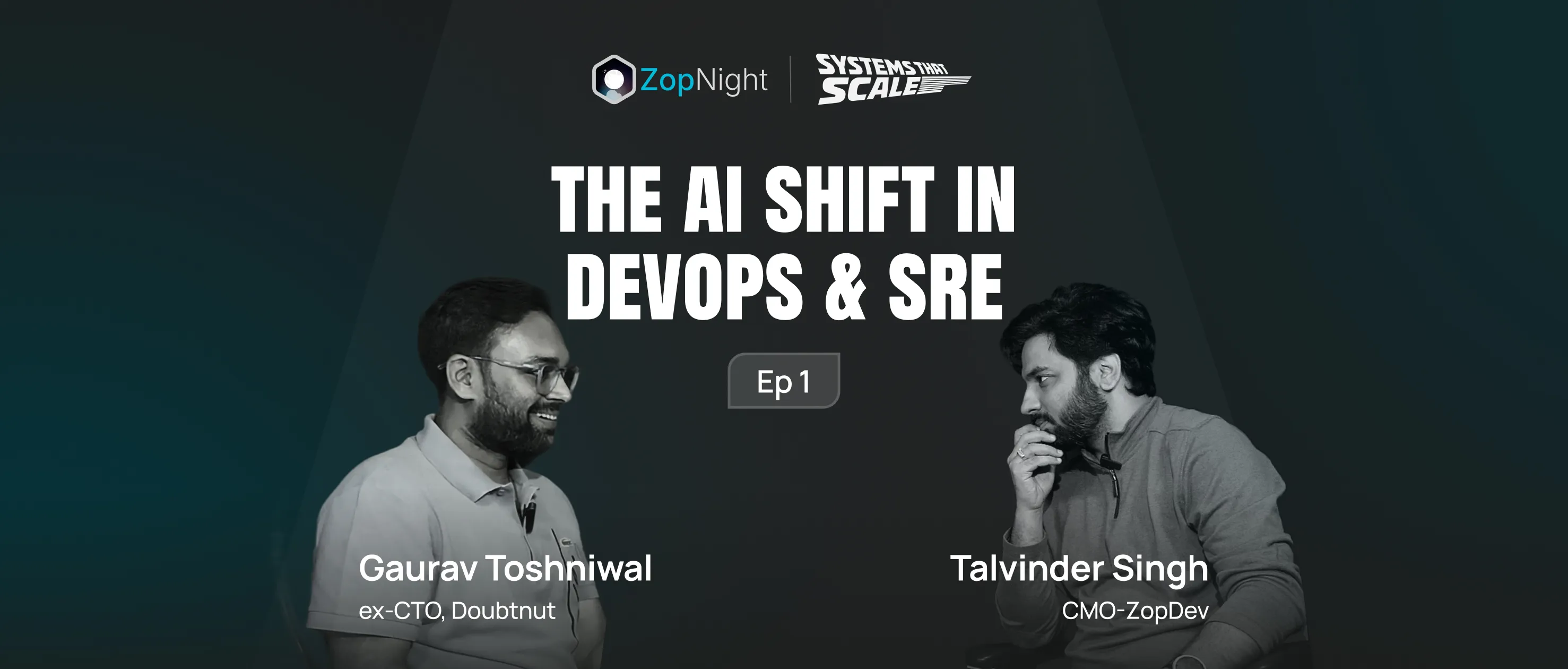
Real lessons from DevOps at scale. Episode 1 of Systems That Scale covers SRE breakdowns, operational complexity, and the rise of AI driven reliability.
One post a week. Sundays. No "10 ways to think about cloud" listicles, just the engineering and FinOps notes we'd want to read.
See. Find. Fix. Automatic.
Connect your first cloud account in under 5 minutes. See your first remediation in under 7. No credit card required.