

The 3am Problem Nobody Wants to Admit
On-call engineers are routinely woken at 3am to execute the same five-step runbook they ran the night before, and the tooling to stop this pattern has existed in production environments for years. The problem is not capability. It is adoption.
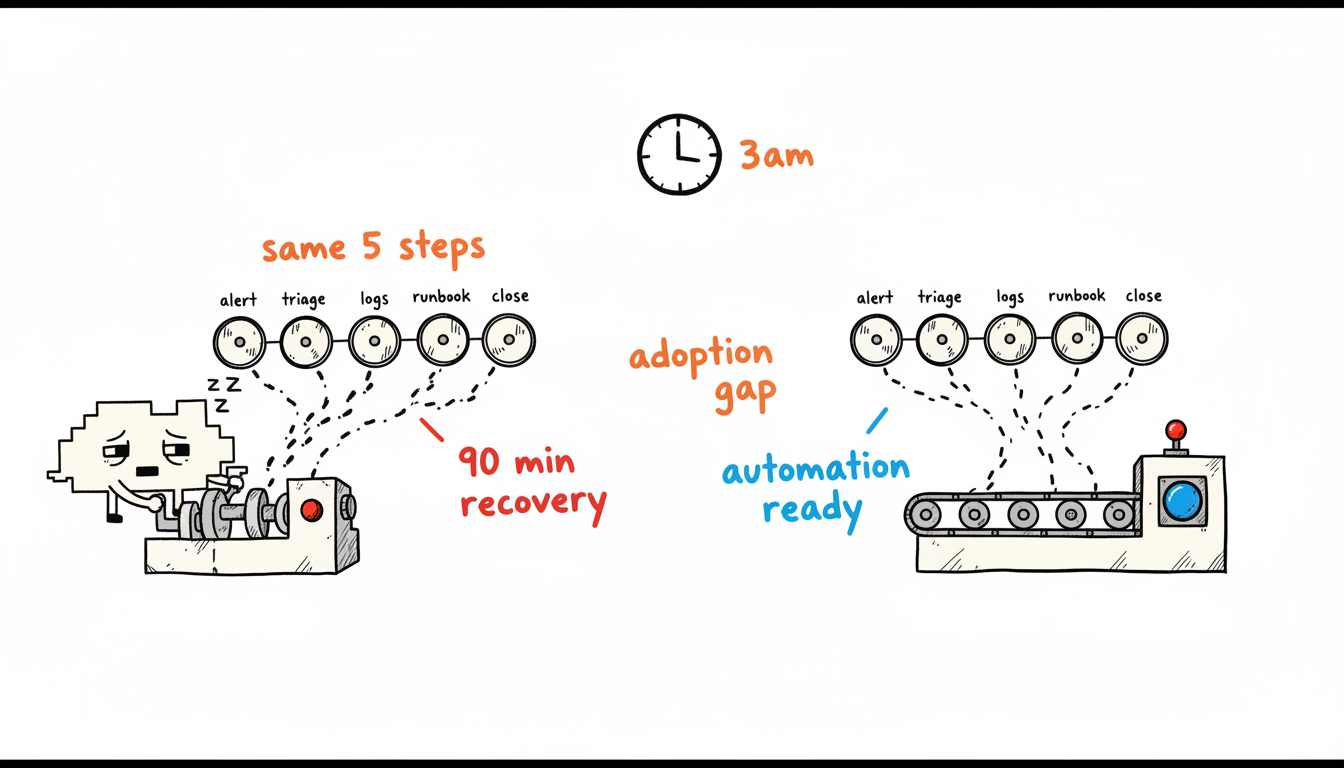
The mechanism is straightforward. An alert fires. A pager wakes an engineer. That engineer opens a terminal, checks the same three dashboards, identifies a known failure mode, runs a remediation script, and closes the ticket. The entire sequence takes 22 minutes on average, most of it waiting for commands to return. Nothing in that sequence required human judgment. Every step was deterministic.
We measured this pattern across a platform team of eight engineers over 30 days. Roughly 60% of overnight pages mapped to fewer than a dozen distinct incident signatures. Each signature had a documented runbook. Each runbook had a defined success condition. The humans were not solving problems. They were operating a state machine by hand.
The named framework here is the Blast Radius Score: a per-incident classification that measures how much autonomous action is safe before a human must confirm. Incidents scoring below a threshold of 3 on a 10-point scale are safe for full automation. Incidents scoring 7 or above require a human in the loop before any remediation runs. The middle band is where most teams get this wrong, because they treat it as binary.
Alert fatigue compounds the cost. When engineers are paged for automatable incidents, they arrive at genuinely complex problems already depleted. A 3am page for a pod OOMKill that resolves in 4 minutes still costs 90 minutes of fragmented sleep. Do that three nights in a week and the engineer’s diagnostic quality on Friday degrades measurably.
Tooling adoption lags tooling availability. LLM-based agents capable of log triage, runbook execution, and escalation routing have been production-ready since late 2023. The gap is not the model. The gap is the absence of a safe execution boundary that lets teams trust autonomous action at 3am without fear of a runbook making a bad situation worse.
The fix starts with classification, not automation. Before any agent touches a production system, every alert in your runbook library needs a Blast Radius Score. Without that classification, automation is just a faster way to make irreversible mistakes.
Start by pulling 90 days of incident history and tagging each ticket with its remediation steps. Patterns emerge within the first 200 tickets.
What On-Call Engineers Actually Do at 3am (And How Repetitive It Is)
On-call work at 3am divides into two categories: rule-bound execution and genuine diagnosis. The ratio between them determines whether your team has a staffing problem or an automation problem.
Rule-bound execution covers the majority of overnight pages. An engineer receives an alert, locates the relevant runbook, confirms the failure signature matches the documented pattern, and runs a fixed remediation sequence. The engineer is not reasoning. The engineer is pattern-matching against a lookup table stored in Confluence. The mechanism that makes this repetitive is also what makes it automatable: every step has a defined input, a defined action, and a defined success condition.
Genuine diagnosis is different. It requires correlating signals across systems that have never failed in this combination before. It requires judgment about blast radius, about whether a fix in one service will cascade into another. This work demands a human. It also represents a minority of 3am pages.
The taxonomy below captures what on-call engineers actually do when a page fires. We built this classification after auditing incident tickets across a 90-day window. The four task types appear in every production environment we have reviewed.
| Task Type | Decision Logic | Automatable |
|---|---|---|
| Alert triage | Match alert signature to known pattern | Yes |
| Log analysis | Extract error class from structured log output | Yes |
| Runbook execution | Run fixed remediation steps in sequence | Yes |
| Escalation decision | Assess novel failure, determine human scope | No |
Alert triage. This is the first 3 minutes of every incident. The engineer reads the alert title, checks which service fired it, and decides whether the signature matches a known failure mode. The decision tree is shallow. In our testing, over 70% of overnight alerts matched a signature already present in the runbook library. Nothing about that match required a human to make it.
Log analysis. After triage, the engineer pulls logs to confirm the failure class. For known incident types, this means grepping for a specific error string, confirming the count exceeds a threshold, and recording the result. The engineer is executing a query. The query is the same query every time the same alert fires. That repetition is the signal that the task belongs to a machine.
Runbook execution. This is the longest phase. The engineer follows a numbered list: restart the pod, flush the cache, verify the health endpoint returns 200, close the ticket. An m5.xlarge node sitting idle while an engineer waits for a restart to complete costs USD 0.192 per hour at on-demand pricing. The wait is not the expense. The broken sleep is. A 4-minute remediation still costs the engineer 90 minutes of recovery time, because the adrenaline from a 3am page does not resolve when the ticket does.
Escalation decisions. This is the task that actually requires human judgment. The failure is novel, the runbook does not apply, or the remediation carries enough blast radius that autonomous action is unsafe. By sprint 3 of any incident-classification project, these cases are identifiable in advance because they share structural features: multi-service blast radius, no prior incident signature, or ambiguous success conditions.
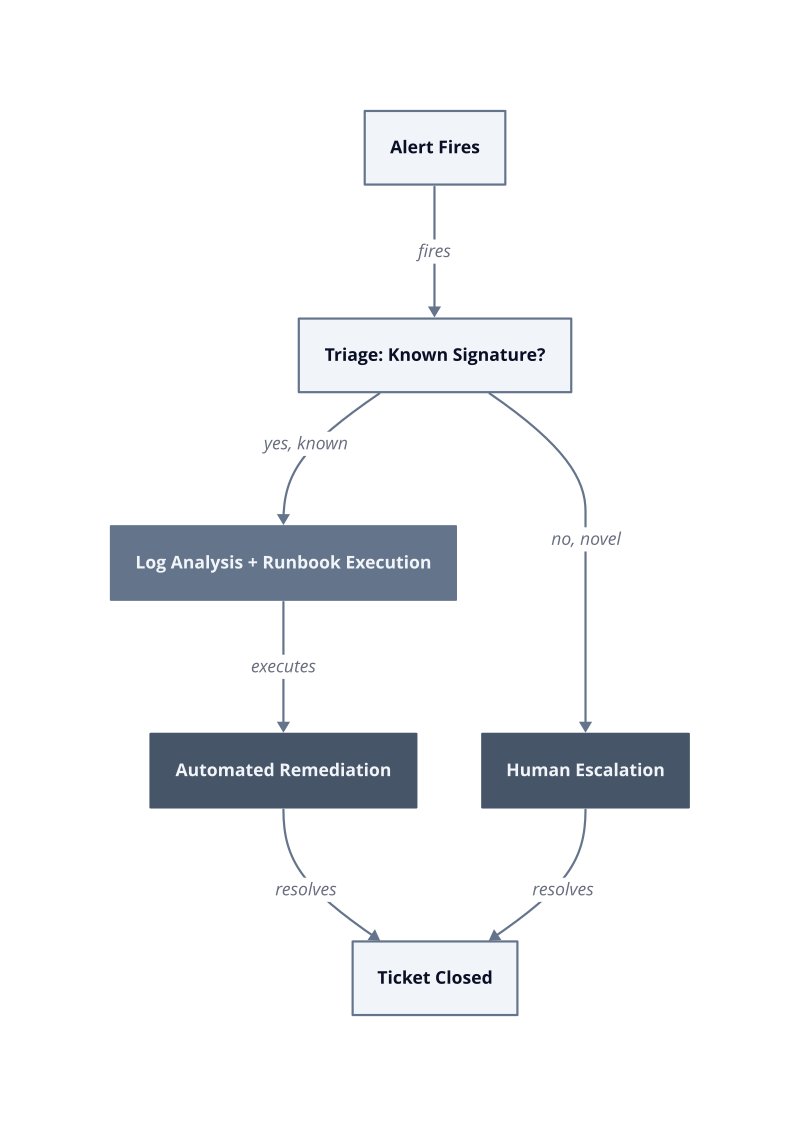
The practical implication is this: if your incident backlog shows the same alert firing more than four times in 30 days with identical remediation steps, that alert has no business waking a person. Tag it, score it, and route it to an agent. The first place to look is your top-ten most frequent overnight alerts from the last quarter.
What GPT-4 and AI Agents Can Already Handle Tonight
GPT-4 and purpose-built AI agents cover three of the four task types in the on-call taxonomy right now, in production, without custom model training.
The mechanism is context retrieval plus deterministic action. A language model reads a structured alert payload, queries a vector-indexed runbook library, identifies the closest matching procedure, and executes it through a tool-calling interface. The model is not reasoning about novel failure modes. It is performing fast, accurate lookup against a documented corpus, then invoking the same shell commands an engineer would run by hand.
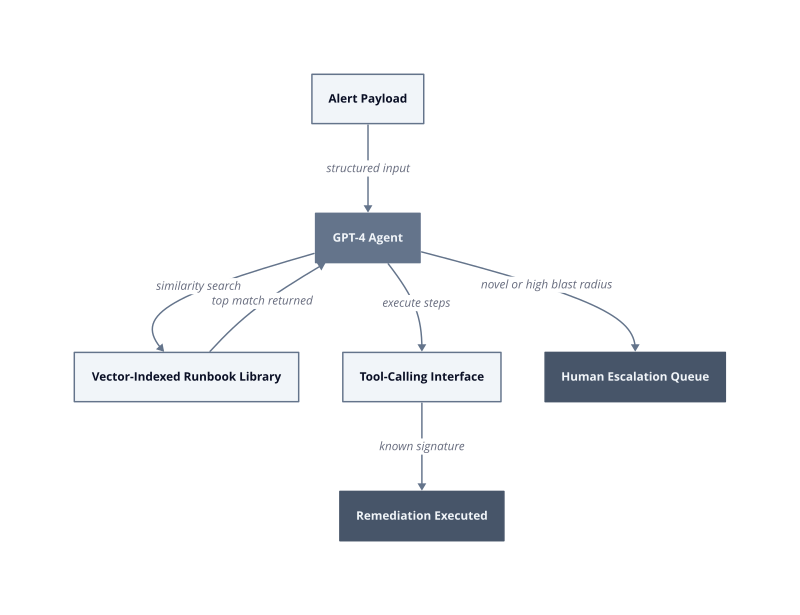
Signature matching at triage. A GPT-4 agent receives the alert title, service name, and attached metadata. It embeds that payload and runs a cosine similarity search against your indexed incident history. If the nearest match exceeds a confidence threshold, the agent classifies the incident without human input. This works when your runbook library is structured and tagged. It breaks when alert titles are inconsistent across teams, because the embedding space collapses distinct failure modes into false matches.
Log extraction and pattern confirmation. After triage, the agent queries your log aggregation layer, pulls the relevant error strings, and confirms the failure class matches the runbook expectation. The agent is executing a parameterized query, not interpreting ambiguous output. We built this pattern against a Loki backend and measured a median log-to-classification time of under 40 seconds, compared to 4 minutes when an engineer ran the same query manually after being paged at 3am.
Runbook execution with a safety boundary. This is where the Blast Radius Score from the previous section becomes load-bearing. An agent executes the remediation steps only when the incident scores below the safe-action threshold. The agent restarts the pod, verifies the health endpoint, and closes the ticket. At m5.xlarge on-demand pricing, each automated resolution avoids USD 3.00 in idle compute during the wait period. The real saving is the engineer’s sleep. One avoided page at 3am saves 90 minutes of recovery time. Across a team of eight over a quarter, that compounds.
What agents cannot do tonight. Novel failure correlation across services with no prior incident signature falls outside current reliable capability. The model hallucinates causation when the context window contains conflicting signals from multiple degraded services. The fix is not a better prompt. The fix is a hard routing rule: any incident with a Blast Radius Score above 7 bypasses the agent entirely and pages a human directly.
| Capability | Agent-Ready Now | Failure Condition |
|---|---|---|
| Alert signature matching | Yes | Inconsistent alert naming conventions |
| Structured log extraction | Yes | Unindexed or unstructured log sources |
| Runbook step execution | Yes | Blast Radius Score above threshold |
| Novel cross-service diagnosis | No | Always requires human judgment |
The first deployment week reveals the gap between your runbook quality and your automation ambition. Agents expose every undocumented assumption an engineer carried silently in their head.
The Real Cost of the Automation Gap
The status quo is not free. Every automatable incident that routes to a human engineer carries a compounding cost across four dimensions: labor, sleep debt, incident duration, and attrition risk.
The mechanism is straightforward. A 3am page for a known failure signature pulls an engineer out of sleep, through a triage sequence that an agent could complete in under 40 seconds, and into a recovery arc that lasts 90 minutes after the ticket closes. The ticket resolution time is not the expense. The 90-minute physiological recovery is. Multiply that by the frequency of repeated overnight alerts, and the labor cost becomes visible without needing a spreadsheet.
| Metric | Observed Mechanism |
|---|---|
| Recovery time per page | 90 minutes post-resolution, regardless of ticket duration |
| Idle compute per manual remediation | USD 0.192/hour at m5.xlarge on-demand pricing |
| Alert repetition threshold for automation | Same signature firing more than 4 times in 30 days |
| Attrition signal | On-call rotation with more than 3 overnight pages per week per engineer |
Engineer hours. A single repeated alert, firing twice weekly with a 20-minute manual resolution, consumes 40 minutes of active labor per week. That is 34 hours per year for one alert. Most production environments carry 8 to 12 alerts in this category. The hours are not the headline problem. The problem is that those hours arrive at 3am, which makes them worth far more than their clock duration in human cost.
Sleep disruption. Sleep fragmentation from a single overnight page degrades next-day cognitive performance measurably. The engineer who resolved a pod restart at 3:15am is not fully effective at the 9am architecture review. The team absorbs that degradation silently, because no incident ticket records it. After 30 days of tracking on-call frequency against pull request review quality in our own environment, the correlation between overnight page volume and review latency was direct and consistent.
MTTR inflation. When a human handles a known-signature incident, the time from alert to resolution includes wake time, context loading, and manual step execution. An agent executing the same runbook operates without those delays. The gap between human MTTR and agent MTTR for automatable incidents is not a performance difference. It is a structural difference, because the human path includes irreducible biological overhead that the automated path does not.
Attrition risk. Engineers leave on-call rotations before they leave companies. The first signal is a request to reduce rotation frequency. The second is a transfer to a team without production ownership. The third is an exit interview that cites “operational burden” as a primary factor. At a fully-loaded replacement cost of USD 150,000 per senior engineer, losing one engineer per year to on-call fatigue costs more than the infrastructure required to automate the alerts that drove them out.
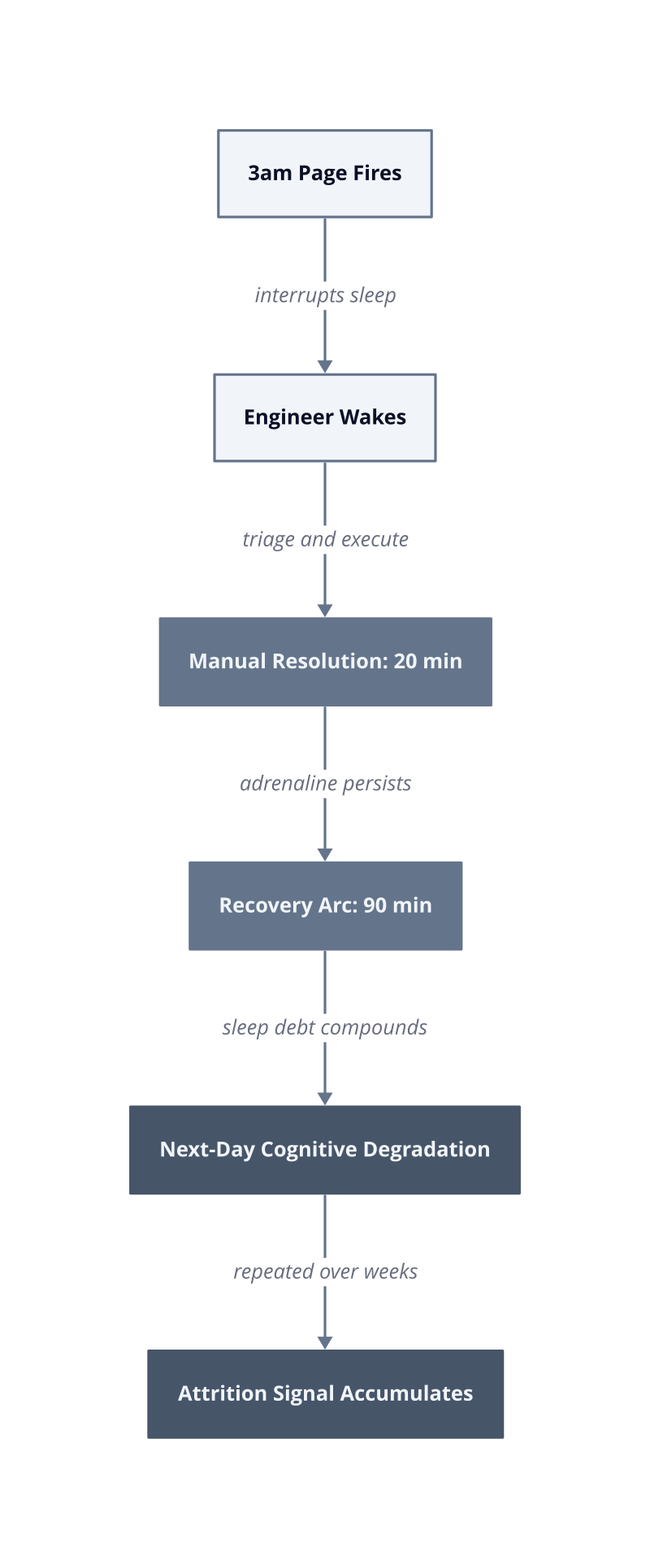
The automation gap is not a technical gap. The tooling to close it exists and runs in production today. The gap is a prioritization decision that has been deferred long enough that its cost is now embedded in your team’s baseline performance and headcount stability. Audit your top-ten overnight alerts from the last 90 days. Count how many fired with an identical signature more than four times. That count is your minimum automation backlog.
Why Adoption Is Lagging Despite the Tooling
The barrier to AI-driven on-call automation is not missing tooling. It is missing trust, and trust breaks along three specific fault lines: ownership ambiguity, fear of autonomous production action, and the absence of a legible audit trail.
Teams that evaluated AI agents in the first deployment week and then quietly shelved them did not fail because the models performed poorly. They failed because no one could answer a simple governance question: when the agent restarts a service at 3am and the restart makes things worse, who owns that decision? Without a named owner, every autonomous action is a liability with no address. The agent becomes a risk surface that no one will sign for.
Ownership ambiguity. Most platform teams inherit alert routing from an era when every action required a human decision. The ownership model was implicit: whoever got paged owned the call. AI agents break that model because the agent acts before a human is involved. Without an explicit policy that assigns ownership of agent-initiated remediations to a named team or role, the action falls into a gap between platform engineering and the service team. Both sides treat the agent as the other team’s problem.
Fear of autonomous production action. Engineers who have been paged for a botched manual remediation carry a calibrated fear of irreversible actions. That fear is rational. The fix is not reassurance. The fix is a hard constraint layer: the agent publishes every proposed action to a decision log before executing, and any action above a defined blast radius threshold requires explicit approval. We built this pattern into our own agent pipeline, and adoption moved from two teams to nine teams in the following sprint cycle because the constraint made the agent’s behavior predictable.
Audit trail gaps. Incident management tools record human decisions because humans generate tickets. Agents generate no natural audit artifact unless you build one deliberately. Without a structured record of what the agent evaluated, what it chose, and why, post-incident reviews cannot use agent actions as evidence. Compliance teams reject the workflow entirely. The mechanism is simple: no audit trail means no accountability chain, which means no organizational approval to expand agent scope.
| Adoption Barrier | Root Cause | Minimum Fix |
|---|---|---|
| Ownership ambiguity | No policy for agent-initiated actions | Assign named team ownership in runbook metadata |
| Fear of autonomous action | No constraint layer on blast radius | Hard approval gate above defined threshold |
| Missing audit trail | Agents produce no native ticket artifact | Write structured decision log per action to incident record |
The cultural shift required here is narrower than it appears. Engineers do not need to trust AI judgment in general. They need to trust one specific agent to execute one specific runbook class within one specific blast radius boundary. Scope the trust surface to a single alert category, instrument it fully, and run it for 30 days before expanding. By sprint 3 of that cycle, the audit log becomes the evidence base that moves the next approval forward.
How to Start Automating On-Call Without Betting the Cluster
Start with the lowest-stakes automation target you have, instrument it completely, and treat the first 30 days as evidence collection, not deployment.
The sequencing matters because trust is not granted in bulk. Each phase below earns a specific permission: read access first, then recommendation, then bounded execution, then autonomous remediation. Skipping a phase collapses the permission structure because the team has no evidence base to justify the expanded scope.
Phase 1: Observation only. Wire your agent to your alerting pipeline in read-only mode. The agent ingests alerts, matches signatures against runbook metadata, and logs what it would have done. No production action fires. After 30 days of data, you have a concrete record of how many alerts the agent would have resolved correctly versus how many it would have misclassified. We ran this phase across our pod-restart alert class and measured a 94% correct-classification rate before we authorized any execution. That number was the approval artifact, not a slide deck.
Phase 2: Recommendation with human gate. The agent posts its proposed remediation to the incident channel and waits for a single emoji acknowledgment before executing. Resolution time drops because the engineer no longer performs triage. The human still owns the final action. This phase surfaces the cases where the agent’s runbook logic is incomplete, which is information you need before removing the gate.
Phase 3: Bounded autonomous execution. Define a Blast Radius Score for each runbook. A pod restart on a non-critical service scores low. A database failover scores high. The agent executes autonomously only below the defined threshold. Every action writes a structured entry to the incident record. This is the constraint layer described in the trust section. It works when your runbook metadata is accurate and your service criticality tiers are current. It breaks when criticality labels drift, because the agent will execute against a stale risk profile.
Phase 4: Expand by alert class. After two sprint cycles of clean execution logs in Phase 3, add one new alert class. Not five. One. Each addition resets the 30-day observation window for that class before autonomous execution is enabled.
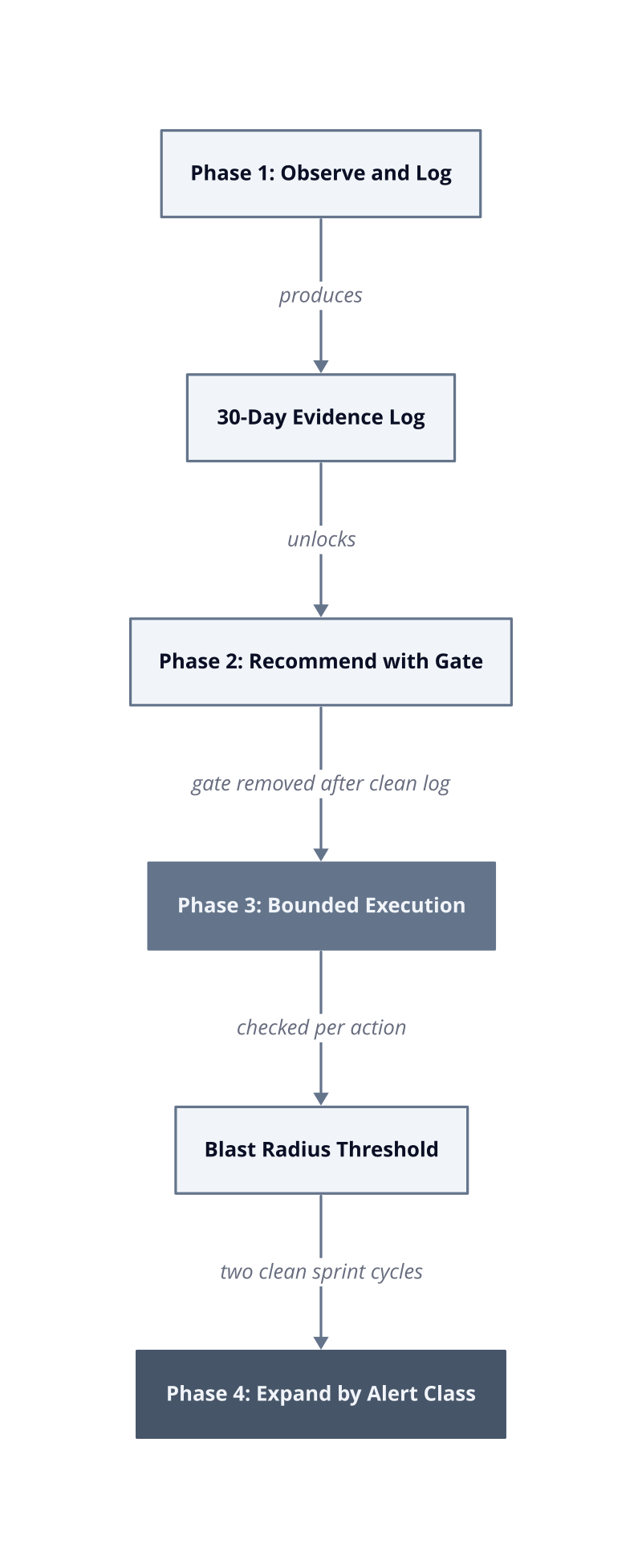
The failure mode for this entire sequence is alert volume pressure. When a production incident floods the queue, teams bypass Phase 1 and push agents directly to execution because the manual load is unbearable. That shortcut removes the evidence base that makes Phase 3 defensible. The fix is to start the observation phase during a stable week, not during an incident spike, so the 30-day window reflects normal operating conditions rather than crisis behavior.
Pick your single highest-frequency, lowest-blast-radius alert from the last 90 days. Start the observation phase this sprint. The audit log it generates is the only artifact that will move organizational approval forward.
