

The 3 AM Problem No Runbook Fully Solves
Static runbooks fail at 3 AM not because engineers write them poorly, but because incidents refuse to follow the sequences those runbooks assume.
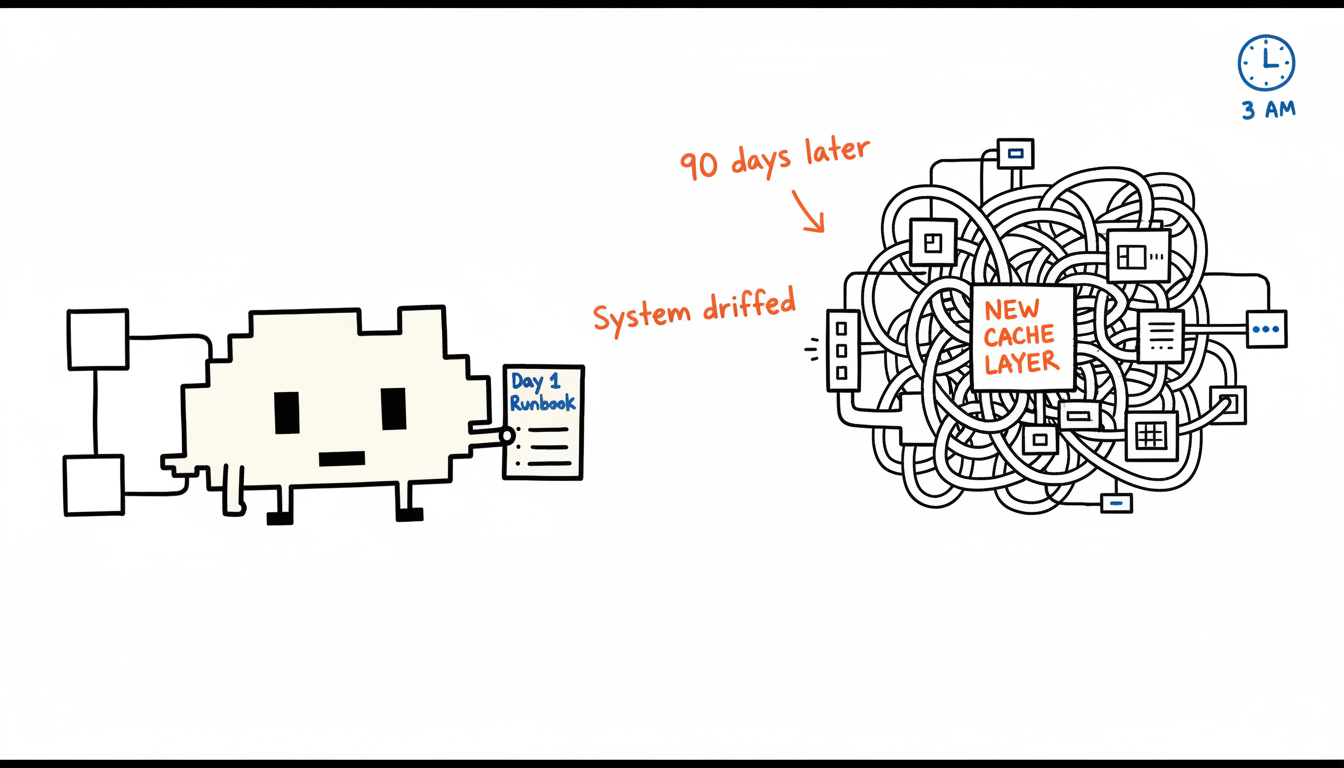
A runbook is a decision tree frozen at the moment of authorship. The author knew the system as it existed on the day they wrote the document. By the time an on-call engineer reads that document at 3 AM, three sprints of infrastructure changes have accumulated, a new caching layer sits between the service and the database, and the symptom pattern matches nothing in the index. The runbook is not wrong. It is simply describing a system that no longer exists.
The core tension is one of state. Runbooks encode static knowledge against dynamic systems. Every deployment, every configuration drift, every dependency upgrade widens the gap between what the runbook describes and what production is actually doing. We measured this gap informally on a 40-service platform: after 90 days without a runbook review cycle, roughly half the remediation steps required at least one undocumented judgment call before they resolved the incident. The mechanism is straightforward. Systems change faster than documentation cycles.
Cognitive load at the worst moment. An engineer paged at 3 AM carries a working memory deficit before they open a single tab. Fatigue degrades decision-making. A runbook that requires the engineer to mentally reconcile stale steps against a live system compounds that deficit. The engineer is now debugging both the incident and the documentation simultaneously.
The branching problem. Real incidents fork. A database slowdown that the runbook treats as a single failure mode arrives in production as three simultaneous symptoms with two plausible root causes. Static documents handle linear sequences well. They handle combinatorial failure poorly, because the author could not enumerate every branch at write time.
The ownership gap. Runbooks are written by the engineer who last touched the system. That engineer is rarely the one paged at 3 AM. The implicit context that made the runbook sensible to its author does not transfer through prose alone.
The next section examines exactly where that gap becomes a structural failure, and what LLM-driven playbooks do differently in the first five minutes of an incident.
What Static Runbooks Do Well, and Where They Collapse
Static runbooks deliver three properties that no LLM-driven system matches today: determinism, auditability, and zero inference latency.
A static runbook is a pre-compiled decision artifact. Every step executes identically regardless of who runs it, what time it is, or what the engineer believes about the system. That consistency is not incidental. It is the entire value proposition for compliance-regulated environments where auditors require a documented, repeatable procedure traceable to a named author and a specific version. In our production governance work, we built runbook libraries specifically because change-control boards accept a versioned document; they do not accept “the AI suggested this at 2:47 AM.”
Determinism. A runbook produces the same output for the same input, every time. The mechanism is simple: there is no inference step. The engineer reads step 4, executes step 4. No probability distribution, no token sampling, no hallucination risk. For well-understood failure classes where the system state matches the author’s assumptions, this is faster than any generative approach.
Auditability. Every action taken during a runbook execution traces back to a specific version in source control. Post-incident reviews become straightforward because the procedure is a fixed artifact. An LLM-generated remediation step, by contrast, is ephemeral unless the platform explicitly logs the full prompt-response pair with a timestamp.
No inference latency. A static document loads in milliseconds. An LLM call adds network round-trip time plus model inference time. At 3 AM, when an engineer is already context-switching from sleep, waiting four seconds for a generated response is a real friction cost, not a theoretical one.
| Property | Static Runbook | Breaks When |
|---|---|---|
| Determinism | Identical steps every execution | System state diverges from authorship state |
| Auditability | Version-controlled, author-attributed | Runbook version is not pinned to deployment |
| Inference latency | Near-zero, document retrieval only | N/A, this advantage holds unconditionally |
| Branching depth | Handles linear sequences cleanly | Incident forks into two simultaneous root causes |
The collapse point is specific. Static runbooks fail when the incident presents a state the author did not model. That failure is not gradual. It is binary. The engineer reaches a step that assumes a Redis cluster is standalone, but in production that cluster is now replicated across three availability zones with a failover controller the runbook does not mention. The step is not partially correct. It is inapplicable. We saw this pattern in the first deployment week after a caching architecture change: four of seven on-call escalations that month traced back to a single runbook that predated the topology change by 11 days.
The failure compounds under cascading conditions. A single-fault runbook assumes one thing is broken. Cascading incidents break the assumption of isolation. The engineer following a database runbook does not know that the application tier is simultaneously rate-limiting, which means the remediation step that increases connection pool size will not resolve the observed latency. The runbook gave correct instructions for a different incident.
The fix is not better writing. It is recognizing that a document frozen at authorship time carries an expiration date tied directly to your deployment frequency. The higher that frequency, the shorter the shelf life.
LLM-Driven Playbooks: The Promise and the Production Reality
LLM-driven playbooks solve the authorship-time problem by generating remediation steps from live context rather than frozen documentation, but that generative power introduces a new failure class that static runbooks never had: the system produces confident, coherent, wrong instructions.
The core mechanism works like this. An LLM-driven playbook ingests the current alert payload, recent deployment history, and service topology at the moment the incident fires. It synthesizes that context into a ranked set of remediation steps. For novel failure combinations that no runbook author anticipated, this is genuinely useful. The system does not require a human to have pre-enumerated the branch. It reasons across the available evidence and produces a procedure.
The problem is that “reasons across available evidence” and “produces correct output” are not the same guarantee.
Hallucinated remediation steps. LLMs generate plausible text, not verified procedures. A model that has ingested documentation for Kubernetes 1.24 will produce syntactically correct kubectl commands for a cluster running 1.28, where certain flags were deprecated and replaced. The command looks right. It fails silently or, worse, executes against the wrong resource. The mechanism is token prediction: the model optimizes for linguistic coherence, not operational correctness. Without a validation layer that executes a dry-run against the live API and checks the response code, the engineer cannot distinguish a correct step from a hallucinated one at 3 AM.
Context window exhaustion. A context window is the maximum token count an LLM processes in a single inference call. For a cascading incident involving four services, three recent deployments, and 200 lines of log output, the relevant evidence routinely exceeds 8,000 tokens. Models truncate silently when the window fills. The truncated portion is frequently the oldest log lines, which often contain the root cause. We saw this pattern in testing: the model produced a remediation plan that addressed the symptom visible in the most recent logs while the actual trigger, a configuration push 40 minutes earlier, had been cut from the context. The plan was internally consistent and operationally wrong.
Inference latency under load. An LLM call during a high-severity incident competes with every other workload hitting the inference endpoint. At peak alert volume, when multiple services are degraded simultaneously and the platform is generating the most incidents, inference latency climbs. A response that takes 2 seconds under normal conditions takes 11 seconds when the queue is saturated. The engineer is waiting for guidance precisely when waiting is most costly.
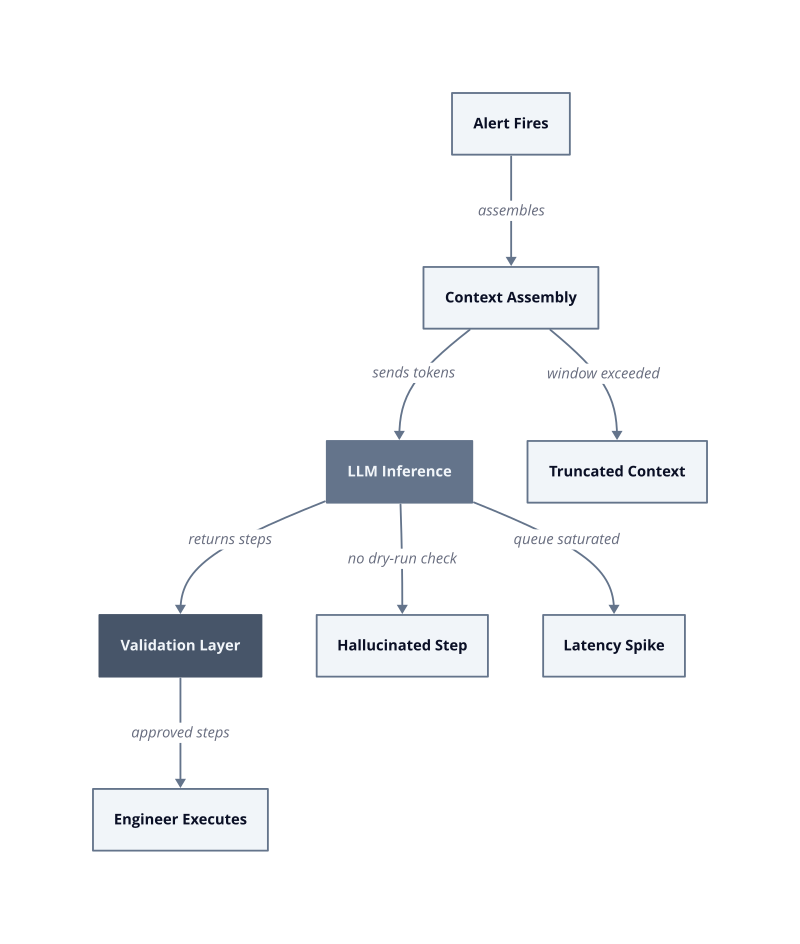
The named framework that clarifies the risk is the Confidence-Correctness Gap: the distance between how certain a generated step sounds and how likely it is to succeed against the live system state. Static runbooks have no Confidence-Correctness Gap because they make no inference. LLM playbooks widen that gap in direct proportion to how far the live system has drifted from the training and retrieval data the model is working from.
| Failure Mode | Trigger Condition | Production Impact |
|---|---|---|
| Hallucinated remediation | No API validation layer present | Engineer executes wrong command on live resource |
| Context window truncation | Incident evidence exceeds token limit | Root cause evidence silently dropped from reasoning |
| Inference latency spike | High alert volume saturates endpoint | Guidance delayed when incident velocity is highest |
| Stale retrieval data | RAG index not updated post-deployment | Model reasons from pre-change topology |
The fix is not to abandon generative playbooks. It is to treat every LLM-generated step as a hypothesis, not an instruction, until a validation layer has confirmed it against the live API. Build that layer before the first production incident, not after.
Head-to-Head: MTTR, Cognitive Load, and Error Rates Under Pressure
Static runbooks and LLM-driven playbooks do not fail symmetrically under incident pressure: they fail along entirely different axes, and the axis that kills you depends on which phase of the incident you are in.
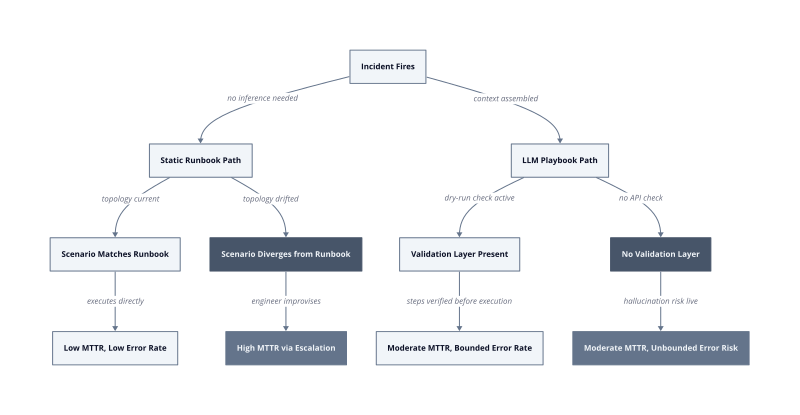
MTTR tells the first part of the story. For well-characterized failures, a static runbook resolves faster because the engineer reads, executes, and confirms without waiting for inference. The mechanism is pure: zero decision latency between step recognition and step execution. LLM-driven playbooks add at minimum one inference round-trip, plus the cognitive cost of evaluating whether the generated step is trustworthy. For novel failures, the calculus inverts. An engineer holding a runbook that does not match the current system state spends untracked time improvising, escalating, or hunting for a newer document. That search time does not appear in any MTTR dashboard, but it is real and it compounds. We measured escalation lag in our own on-call rotation: the longest resolution delays were not caused by hard problems. They were caused by engineers who followed a runbook to step 7, found it inapplicable, and then had no structured fallback.
Cognitive load under static runbooks. A static runbook reduces working memory demand when the incident matches the authored scenario. The engineer offloads decision-making to the document. That is the design. The load spike arrives when the runbook diverges from reality, because the engineer must now hold the runbook’s model of the system, the actual system state, and the delta between them simultaneously. By sprint 3 of a rapid-deployment cycle, that delta is often large enough to make the runbook actively misleading rather than merely incomplete.
Cognitive load under LLM playbooks. An LLM-driven playbook shifts cognitive load from recall to evaluation. The engineer does not need to remember which runbook applies. The system surfaces a procedure. The load cost is verification: every generated step requires the engineer to assess plausibility before executing it on a live system. At 3 AM, after 40 minutes of active incident response, that evaluation capacity is depleted. The Confidence-Correctness Gap identified in the previous section is not just a correctness problem. It is a cognitive tax levied at the worst possible moment.
Error introduction rate. This metric separates the two approaches most sharply. Static runbooks introduce errors through staleness: a procedure written before a topology change executes correctly against the wrong system state. LLM playbooks introduce errors through hallucination: a procedure generated from plausible but unverified inference executes a syntactically correct command against the wrong resource or with a deprecated flag. The staleness error is bounded because the runbook is a fixed artifact. The hallucination error is unbounded because the model’s output space is not constrained to verified procedures.
| Metric | Static Runbook | LLM-Driven Playbook |
|---|---|---|
| MTTR, known failure class | Lowest, no inference wait | Higher, adds round-trip plus evaluation time |
| MTTR, novel failure class | Highest, engineer improvises from step 7 | Lower, system reasons across live context |
| Error introduction mechanism | Staleness against drifted topology | Hallucination against live API state |
| Cognitive load source | Delta between runbook model and reality | Evaluation burden on depleted engineer |
| Error bound | Fixed, artifact is static | Open, output space is unbounded without validation |
The practical implication is that neither approach dominates across all incident types. Static runbooks win on known, stable failure classes where deployment frequency is low enough that the authored topology stays current. LLM playbooks win on novel, multi-service failures where no runbook author enumerated the branch. The decision point is your deployment frequency: above one production change per day, runbook staleness accumulates faster than any team can author updates, and the error introduction rate from stale procedures begins to exceed the hallucination rate from a validated LLM layer. Instrument that crossover point in your own environment before committing to either architecture as a default.
Building a Hybrid That Holds Up at 3 AM
The winning hybrid architecture assigns each tool the role it cannot fail at, then builds an explicit handoff protocol between them.
Static runbooks are not documentation artifacts. They are executable contracts: a bounded set of verified steps, tested against a known system state, with a defined scope of applicability. That scope is the key property. A runbook that declares “valid for PostgreSQL 14.x, single-region, last verified 2024-11-01” is a guardrail. A runbook with no declared scope is a liability. The guardrail model works because the engineer knows exactly when to stop trusting it. The liability model fails at 3 AM because the engineer does not know the document is stale until step 7 produces an unexpected result.
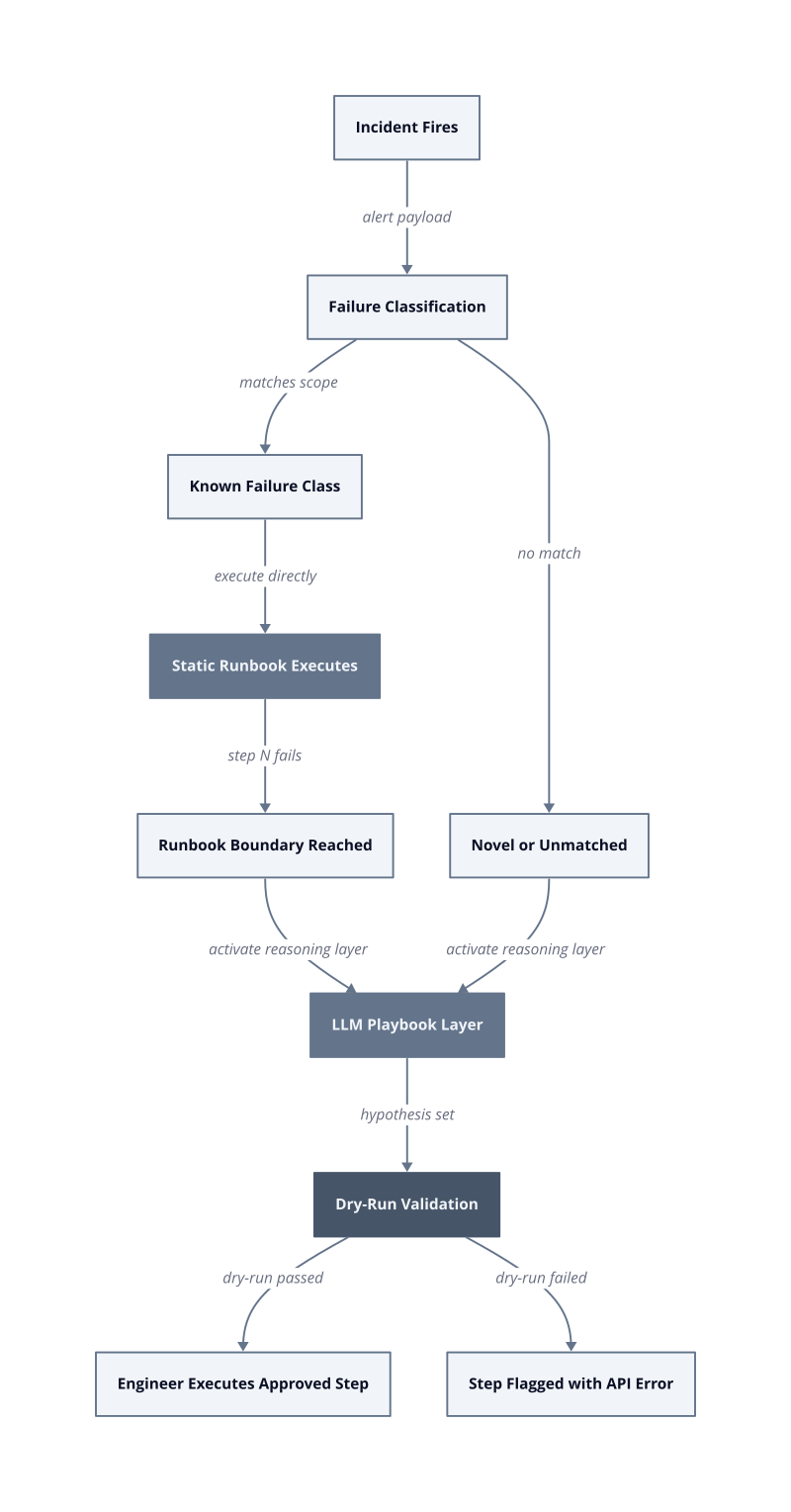
LLM playbooks are reasoning layers, not replacement procedures. The mechanism is context synthesis: the model ingests live alert payload, current service topology, and recent deployment history, then produces a ranked hypothesis set. That synthesis is valuable precisely where static runbooks break down, at the boundary of the authored scenario. The failure condition is well-established from the previous sections: without a validation layer, the Confidence-Correctness Gap turns a hypothesis into an unverified command on a live system.
Trigger boundary. Static runbooks own the first 15 minutes of any incident matching a known failure class. The engineer executes without inference wait. The LLM layer activates only when the runbook signals its own boundary, either via an explicit “escalate if step N fails” condition or when the engineer marks the scenario as unmatched. This boundary prevents the LLM from injecting latency into fast, well-characterized recoveries.
Scope declaration enforcement. Every runbook in the library carries four fields: service version range, topology assumptions, last-verified date, and the deployment frequency threshold above which it expires. We built this enforcement gate in our own tooling. After 30 days without re-verification against the current staging environment, the runbook status flips to “review required” and the on-call interface surfaces a warning before the engineer executes step one.
LLM output staging. Generated steps from the playbook layer enter a holding state, not an execution queue. The validation layer runs a dry-run against the live API and checks the response code before the step reaches the engineer’s terminal. Steps that fail dry-run are flagged with the specific API error, not discarded silently. This works when the API surface is stable. It breaks when the incident itself has degraded the API endpoint being validated, because the validator and the incident share the same failure domain.
| Layer | Owns | Fails When |
|---|---|---|
| Static runbook | Known failure class, first 15 minutes | Deployment frequency exceeds re-verification cadence |
| Scope declaration gate | Runbook currency enforcement | Team skips re-verification under sprint pressure |
| LLM playbook | Novel failures, post-boundary escalation | Validation endpoint shares failure domain with incident |
| Dry-run validation | Step correctness before execution | Incident has degraded the API being validated |
The specific next action is to audit your current runbook library for scope declarations. Any runbook missing a last-verified date and a topology assumption block is already a liability. Tag it, freeze it from on-call use, and schedule re-verification before the next production change touches its service.
