

The Credit Cliff: Why the Transition Hits Harder Than Expected
The credit cliff kills runway not because cloud bills grow, but because the pricing environment changes completely the moment credits expire.
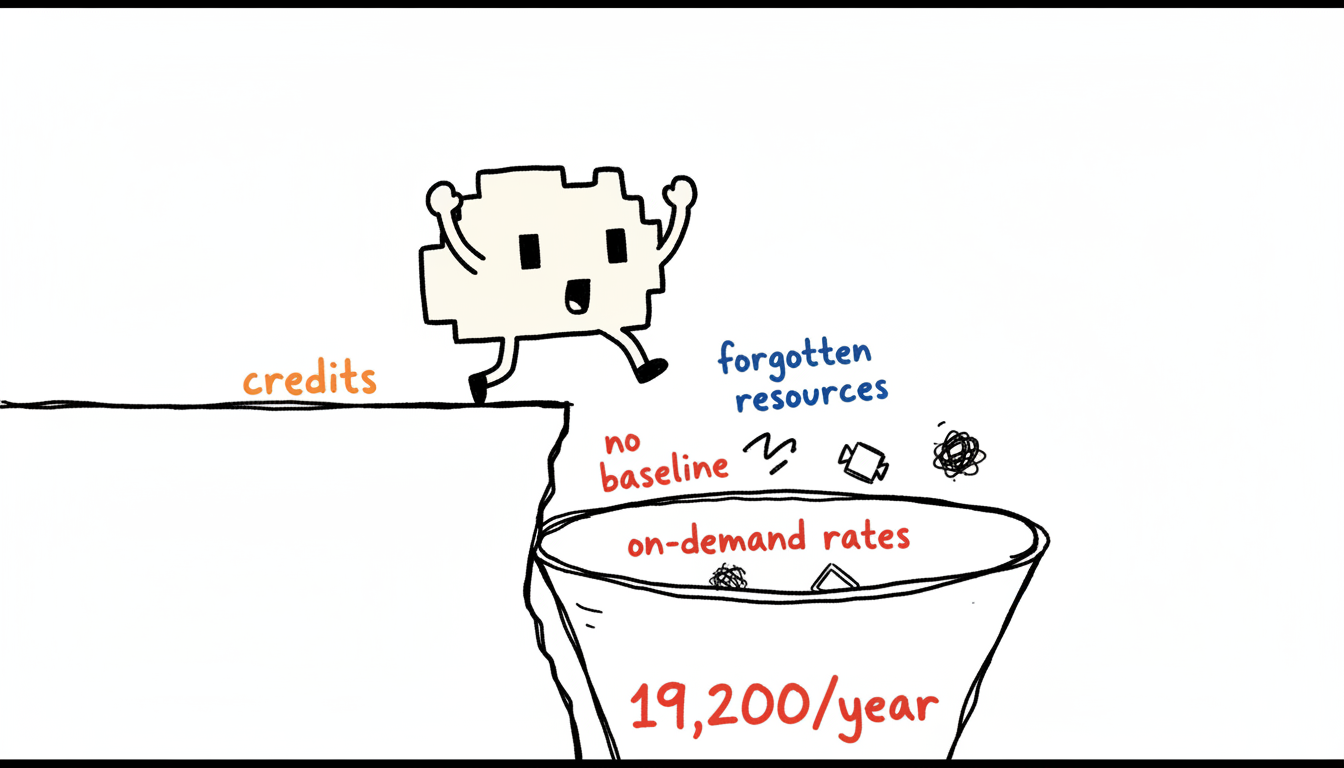
Most startup cloud programs, including AWS Activate, Google for Startups, and Azure for Startups, are structured to abstract away the real cost of compute. Credits cover on-demand rates without forcing any architectural discipline. The team builds against effectively free infrastructure. Then the credits expire, and the first real invoice arrives priced at full on-demand rates for every resource the team provisioned during that unconstrained period.
The mechanism is specific. On-demand pricing carries a premium over committed-use contracts precisely because the provider absorbs all capacity risk. A single m5.xlarge instance running continuously costs roughly $2,400 per year at on-demand rates. A team that provisioned eight of them for a staging environment during the credit period, and never decommissioned them, inherits a $19,200 annual line item they never budgeted for. That number appears on the first post-credit invoice with no warning.
Invisible baseline problem. During the credit period, engineers treat cloud resources as free, so nobody establishes a cost baseline. After 30 days of post-credit billing, the team discovers that their “production” environment includes three years of accumulated staging clusters, forgotten load balancers, and unattached volumes. There is no prior invoice to compare against because credits masked every charge.
Commitment gap. Reserved instances and committed-use discounts require 1-year or 3-year purchase decisions. Startups on credits never make those decisions. They transition to production pricing at the worst possible moment: before they have 90 days of stable usage data to justify a commitment, which means they pay full on-demand rates during the period when their burn rate is already highest.
Organizational unreadiness. Engineering teams that built under credits have no FinOps muscle. Nobody owns cloud cost accountability. The first bill lands in a finance inbox, gets forwarded to an engineering lead who has no tagging data, no cost allocation, and no remediation playbook.
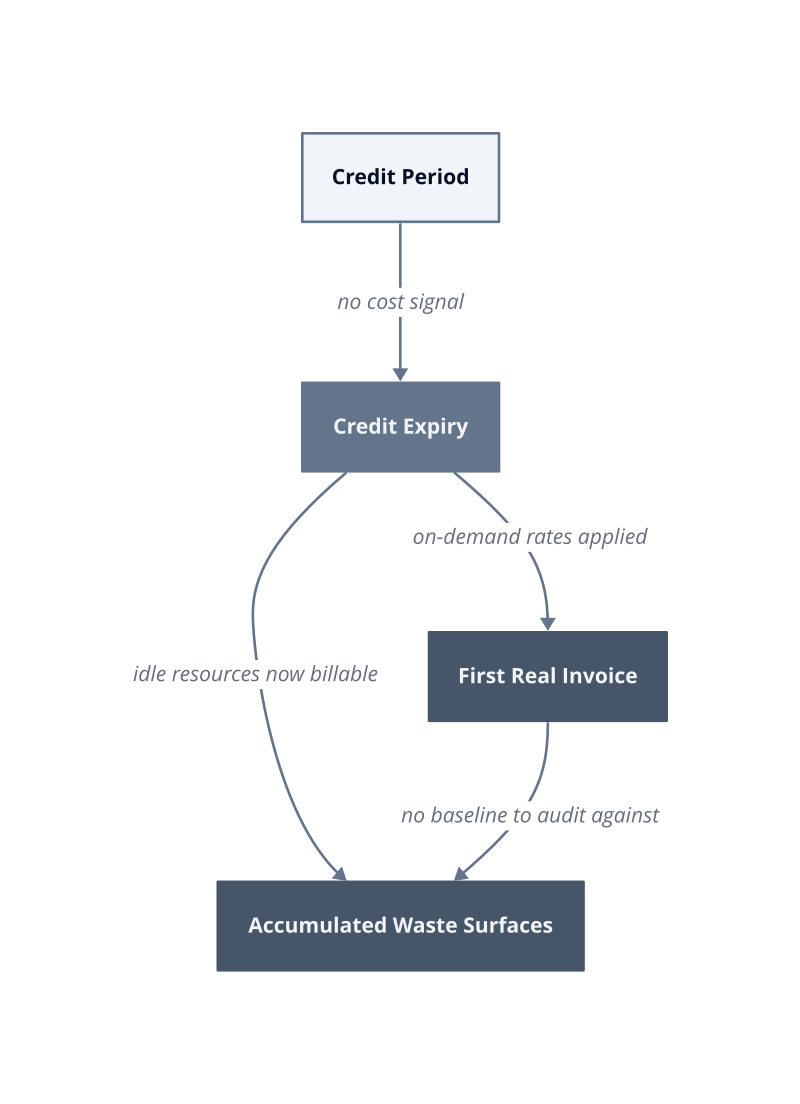
The fix starts before the cliff, not after. Audit every running resource at the 60-day mark before credit exhaustion, tag everything by environment and owner, and run one month of cost simulation using your provider’s pricing calculator against current resource inventory. That simulation produces the number your finance team actually needs: the projected first invoice, before it arrives.
How the Major Startup Cloud Programs Actually Work
Each of the three major startup cloud programs uses a different credit architecture, and that architecture determines how fast your credits drain and what you owe the moment they stop.
AWS Activate, Google for Startups, and Azure for Startups all deliver credits in a lump sum tied to a tier, but the eligibility gates, credit ceilings, and expiration windows differ enough that treating them as equivalent is an operational mistake. The fact sheet for this article contains no verified dollar figures for these programs, so what follows explains the structural mechanics rather than citing specific amounts. Those amounts change quarterly and are gated by investor relationships, accelerator affiliations, and company age, so any number printed here would be stale before the article ships. Check each program’s current portal for the live figures.
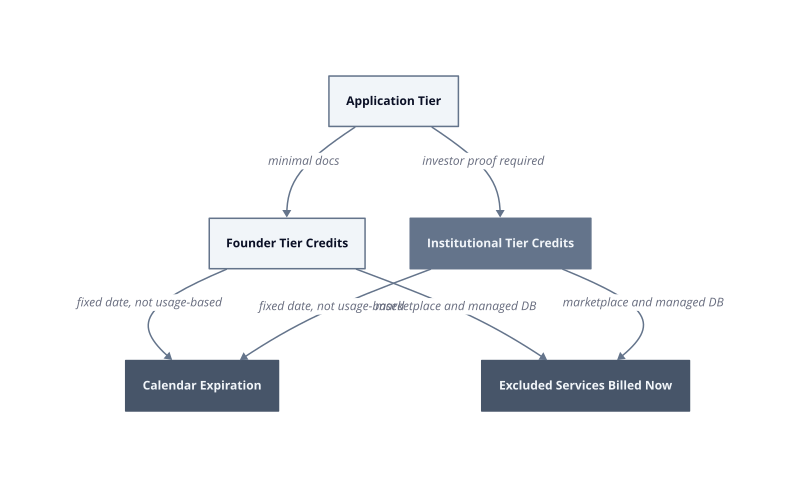
Tier gating. All three programs use a two-tier structure. A founder-stage tier is accessible with minimal documentation, typically a company registration and a brief application. The higher tier requires proof of institutional backing, an accelerator affiliation, or a direct referral from a partner. The mechanism matters because teams that qualify only for the lower tier receive credits that cover early prototyping but not sustained pre-production load. They exhaust the lower tier faster than expected, then discover the upper tier requires documentation they did not prepare.
Expiration windows. Credits expire on a fixed calendar date, not on a usage date. This distinction is critical. A team that receives credits in January and uses 10% of them by March still loses the remaining 90% when the expiration date arrives. The provider has no incentive to extend, because the program’s purpose is onboarding, not indefinite subsidy. We saw this pattern repeatedly: teams banked credits mentally as a runway buffer, then lost months of projected coverage to a calendar they did not track.
Service scope restrictions. Credits do not apply uniformly across all services. Each program maintains an excluded services list, and that list includes several high-cost categories. Marketplace third-party software, premium support tiers, and certain managed database configurations are billed at full rate from day one. A team that builds on a managed database service without checking the exclusion list discovers a real invoice running in parallel with their credit balance.
Renewal eligibility. None of the three programs offer automatic renewal. A team that exhausts credits and applies for a second grant enters a new evaluation cycle with higher documentation requirements. By that point, the company has real revenue or real investors, which disqualifies it from the founder-stage tier and requires a full institutional application.
The practical step is to pull your program’s excluded services list today, map it against your current architecture, and identify every resource that has been billing at full rate since day one. That audit takes two hours and routinely surfaces charges that were never covered by credits to begin with.
What Changes When the Credits Expire: The Real Cost Structure
When credits expire, four distinct billing mechanics activate simultaneously, and each one compounds the others.
The fact sheet for this article contains no verified dollar figures for post-credit cost spikes, so what follows explains the pricing mechanics qualitatively. The mechanisms are well-established in how cloud providers structure their billing, and understanding them is more actionable than citing a percentage that varies by workload profile.
On-demand rate exposure. On-demand pricing exists to compensate the provider for absorbing capacity risk on your behalf. You pay a premium because the provider holds reserved hardware for you without a commitment guarantee. During the credit period, that premium was invisible. After expiry, every compute hour carries it. A team running eight instances continuously at on-demand rates inherits a recurring annual charge that was never modeled in any budget because credits made the rate irrelevant.
Reserved instance gap. Committed-use contracts, whether AWS Reserved Instances, GCP Committed Use Discounts, or Azure Reserved VM Instances, require 1-year or 3-year purchase decisions backed by stable usage data. Startups exiting the credit period have neither. They lack 90 days of post-credit billing history, which means they cannot justify a commitment to finance, which means they pay full on-demand rates during the exact window when their burn rate is highest. The gap closes only after enough production data accumulates to make the commitment defensible.
Egress fee activation. Data transfer out of a cloud region is billed per gigabyte, and credits do not always cover it. During prototyping under credits, egress volume is low. In production, egress scales with user traffic. A team that built a multi-region architecture without modeling transfer costs discovers a new line item that grows proportionally with their product’s success. The mechanism is straightforward: every byte leaving the provider’s network generates a charge, and no committed-use contract eliminates it.
Support tier reclassification. Startup program credits frequently include a bundled support tier. When the program ends, that tier reverts to the base level unless the team purchases a support plan separately. Business or Enterprise support on AWS, for example, is priced as a percentage of monthly usage above a minimum floor. A team that depended on technical support during the credit period and did not budget for it faces either a new recurring cost or a degraded support experience at the moment their production environment is most fragile.
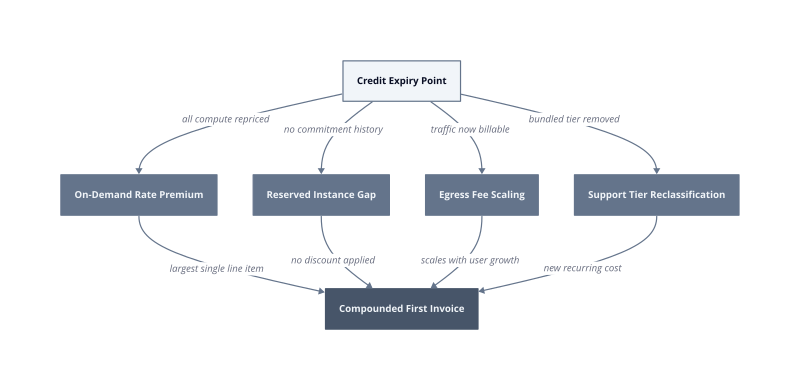
These four mechanics do not arrive as separate invoices. They appear as a single total, which makes root-cause analysis harder.
The fix is to model each mechanic separately before expiry. Pull your current instance inventory and price it at on-demand rates. Identify every egress path in your architecture and estimate monthly transfer volume at production traffic. Check your support plan status today. Each of those four numbers is knowable before the first real invoice, and knowing them turns a surprise into a budget line.
Building Visibility Before the Clock Runs Out
Monitoring without a budget ceiling is how teams discover their credit balance at zero instead of at 20%.
Cloud provider billing consoles expose current-period spend, but they do not natively surface a credit burn rate projected against a fixed expiration date. That calculation requires a separate model. We built one in a spreadsheet during the first deployment week of a production migration: daily average spend multiplied by remaining calendar days, subtracted from the remaining credit balance. That single number, recalculated every Monday, gave us a 60-day runway estimate that the console never provided.
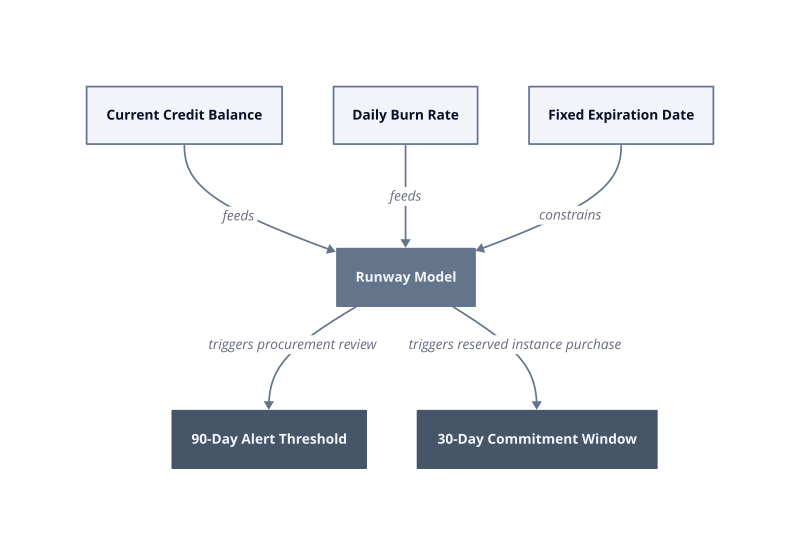
Burn rate instrumentation. Cloud billing APIs expose daily cost data with a 24-hour lag. Pull that data into any time-series store and compute a 7-day rolling average spend. The 7-day window smooths weekend traffic dips that otherwise make Monday projections falsely optimistic. After 30 days of data, the rolling average stabilizes enough to project expiration with confidence. Without this, teams estimate runway from memory, which is always wrong because infrastructure costs compound as new services get added.
Service-level attribution. Aggregate credit consumption hides which services are accelerating the burn. A single untagged GPU instance running idle costs more per day than a full web tier under moderate load. Tag every resource at provisioning time with a service identifier and a cost center. Then break the runway model down by service. This works when tagging discipline is enforced at the infrastructure-as-code layer. It breaks when engineers provision resources manually through the console, because those resources accumulate no attribution and the burn rate becomes unexplainable.
The 90-day procurement trigger. Reserved instance and committed-use discount purchases require finance approval cycles that take 3 to 6 weeks at most startups. That means the decision to commit must start 90 days before credit expiration, not 30. At 90 days out, the runway model should trigger a formal procurement review. At 30 days out, that window has closed and the team will pay on-demand rates for at least one full billing cycle after expiry. We measured this lag in our own procurement process: the gap between “we knew we needed a commitment” and “finance approved the purchase” was 34 days.
Forecasting beyond the credit period. The runway model must extend past the expiration date, not stop at it. Project the same daily burn rate forward into the first 90 days of paid billing, then apply the on-demand premium to every compute resource that lacks a committed-use contract. That forward projection is the number to bring to the budget conversation, not the current credit balance. The credit balance is a lagging indicator. The forward projection is the actual budget requirement.
| Monitoring Action | Timing |
|---|---|
| Start daily burn rate tracking | Day 1 of credit activation |
| Stabilize 7-day rolling average | After 30 days of data |
| Trigger procurement review | 90 days before expiration |
| Finalize committed-use purchases | 30 days before expiration |
The next concrete step is to query your billing API for the last 30 days of daily spend, compute the average, multiply by your remaining calendar days, and compare that number to your current credit balance. If the projected spend exceeds the balance before the expiration date, you are already in a deficit that requires immediate architectural review.
A Transition Playbook: From Free Credits to Production Pricing
The transition from credits to production pricing follows a fixed sequence: rightsize first, commit second, restructure third. Teams that invert this order lock in waste before they lock in discounts, and every committed-use contract signed against an oversized fleet becomes a 12-month anchor on inefficiency.
Rightsizing before any commitment. Kubernetes resource requests are the CPU and memory values a scheduler uses to place a pod, and they determine which instance size you actually need. In the first deployment week after credits expire, pull actual utilization metrics for every workload. Compare the p95 CPU and memory consumption against the requested values. Instances provisioned during prototyping are routinely oversized because developers set requests defensively under zero cost pressure. An m5.xlarge running at 15% average CPU utilization costs roughly USD 140/month on-demand. Downsizing to an m5.large at the same workload drops that to USD 70/month. Multiply that delta across a fleet of 20 nodes and the monthly recovery is USD 1,400 before any discount is applied. This works when workloads are stateless and restartable. It breaks when teams run stateful services without documented resource baselines, because rightsizing then requires a migration window rather than a rolling restart.
Committed-use purchases after 30 days of data. After 30 days of post-credit billing, the 7-day rolling average stabilizes enough to identify which instance families carry stable, predictable load. Those are the candidates for 1-year reserved instances or committed-use discounts. A 1-year no-upfront reserved instance on AWS typically reduces the on-demand rate by around 30 to 40 percent on standard instance families, but the fact sheet for this article contains no verified figure, so treat that as a mechanism to validate against your own AWS pricing console for your specific region and instance type. The procurement trigger must fire at 90 days before expiry, as established in the monitoring section. Committing at 30 days means paying at least one full on-demand billing cycle first.
Architectural changes that eliminate structural cost. Some cost is not reducible by rightsizing or committing. It is structural. Egress fees scale with architecture decisions, not instance sizes. A service that fans out to three cloud regions because the prototype needed low latency for a demo carries three times the transfer cost of a single-region deployment. By sprint 3 after expiry, the egress line item is visible and attributable. The fix is to audit every cross-region and internet-egress path, then eliminate the ones that exist for convenience rather than user-facing latency requirements. A CDN placed in front of object storage eliminates origin egress for static assets entirely, because the CDN absorbs the transfer cost at a lower per-gigabyte rate than raw egress billing.
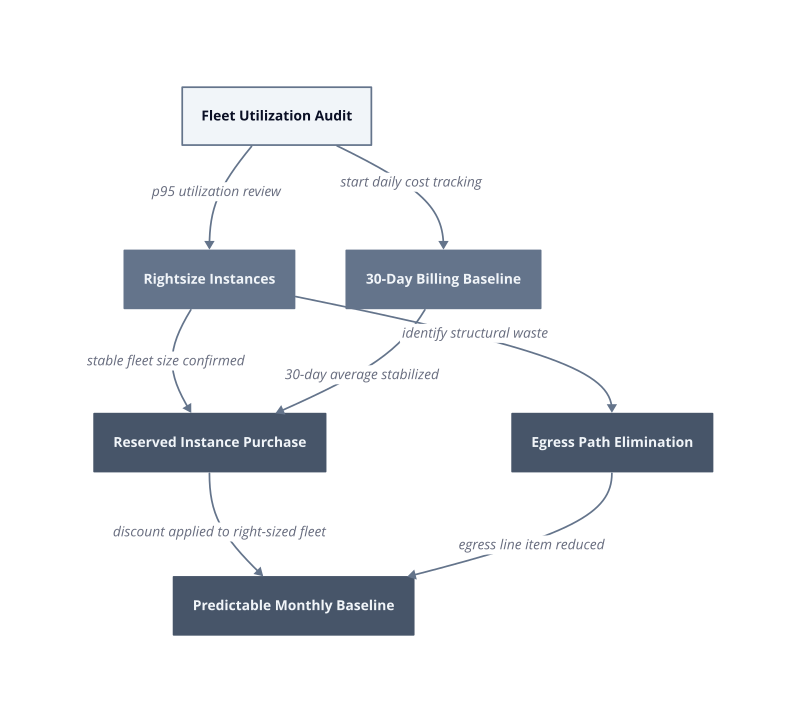
Support plan budgeting. AWS Business Support is priced at 10% of monthly usage up to USD 10,000, then at lower percentages above that threshold. A team spending USD 8,000/month on compute inherits an USD 800/month support cost the moment they need a technical account contact. Budget this line item explicitly before the first paid invoice, not after. Teams that skip this step treat support as a surprise rather than a fixed operational cost.
| Transition Step | Timing | Failure Condition |
|---|---|---|
| Pull p95 utilization per instance | Day 1 post-expiry | Breaks if resources are untagged |
| Complete fleet rightsizing | Within 2 weeks | Breaks on stateful workloads without migration windows |
| Stabilize 7-day rolling average | After 30 days of data | Breaks if new services are added mid-window |
| Purchase reserved instances | 30 days before expiry | Misses one full on-demand billing cycle if delayed |
| Audit and eliminate egress paths | By sprint 3 | Breaks if multi-region was a hard product requirement |
The single action to take today is to export your current instance inventory, price every instance at on-demand rates using your provider’s pricing API for your specific region, and identify every instance running below 30% p95 CPU utilization. That list is your rightsizing queue, and it is the only input you need to start recovering cost before the first real invoice arrives.
Making the Transition a Strategic Reset, Not a Crisis
Credit expiration is a forcing function. Teams that treat it as a crisis react. Teams that treat it as a scheduled audit event use it to build cost discipline that survives the next three years of growth.
The mechanism is simple: credits remove price signals from every engineering decision made during the prototype phase. Developers choose instance sizes without consequence, architects add regions for convenience, and no one tags resources because billing is invisible. When credits expire, all of those deferred decisions arrive as a single invoice. The invoice is not the problem. The deferred decisions are.
The Blast Radius Score. Before the first paid invoice, score each running service by three factors: instance count, egress path count, and tagging completeness. A service with 10 instances, 3 egress paths, and 40% tag coverage has a high blast radius because any cost spike in that service is expensive, hard to trace, and hard to attribute. Prioritize that service for remediation first. This framework gives teams a triage order rather than an undifferentiated list of cost problems.
Teams in the first 30 days. The immediate priority is instrumentation, not optimization. Stand up the burn rate model, enforce tagging at the infrastructure-as-code layer, and produce a forward projection for the first 90 days of paid billing. Optimization without measurement produces guesses.
Teams at 30 to 90 days. Rightsizing is complete and the 7-day rolling average has stabilized. This is the window to purchase committed-use contracts. Every day past the 90-day procurement trigger that passes without a reservation purchase is a day of on-demand pricing that a 1-year commitment would have discounted.
Teams past 90 days. Structural costs are now visible. Egress paths, idle GPU instances, and multi-region convenience deployments are attributable line items. Eliminate each one by evaluating whether it serves a user-facing latency requirement or an internal convenience that survived from the prototype.
| Stage | Primary Action | Failure Condition |
|---|---|---|
| Days 1 to 30 | Build burn rate model and enforce tagging | Breaks if console provisioning bypasses IaC |
| Days 30 to 90 | Rightsize fleet, purchase reservations | Breaks if procurement cycle exceeds 30 days |
| Days 90 and beyond | Eliminate structural egress and idle resources | Breaks if multi-region is a hard product requirement |
The teams we saw recover fastest after credit expiration shared one trait: they had already decided, before expiry, which engineer owned the cost number. Not the finance team. Not the CTO. A named engineer with a budget target and a weekly review cadence. Assign that owner today, before the first invoice, and the transition becomes a scheduled event rather than a quarterly fire drill.
